
There is no "common law divorce", but you still need to resolve things

Millions of Canadians live in marriage-like partnerships without a marriage certificate. When those common law partnerships end, the legal path forward is fundamentally different from a divorce. And for many people, that difference comes as a shock.

What "separation" means for common law couples

The most important thing to understand is that here is no such thing as "common law divorce" or a "common law marriage" in Canadian law. Only married couples can divorce. A common law relationship ends the moment one party or both parties decide to live separately. There is no court application required. You are separated when you separate and no longer live together.

Once separated, there is no further legal step required to formally end the relationship, and you are free to move forward, including entering into new relationships. This is very different from married couples, who must apply for a divorce order under the federal Divorce Act before they can legally remarry. 

When court involvement is still necessary

Not needing a "divorce" does not mean disputes resolve themselves. Separating couples frequently need provincial family courts for questions around property division, support and children, and common law partners in some provinces have significantly fewer automatic legal protections than married spouses. 

This page explains the legal reality of common law separation across Canada: what the law says, how it varies by province, what rights you have, and what steps to take to protect yourself and your family.

Source: Justice Canada – Separation and Divorce

What does "common law" actually mean in Canada?

There is no single definition of "common law" in Canada. The threshold depends on what you're asking about and which province you live in.

The federal definition

The Canada Revenue Agency defines a common law partner as someone you have lived with in a conjugal relationship for at least 12 continuous months, or if you have a child together by birth or adoption. This is relevant for all federal purposes: income taxes, Canada Pension Plan benefits, Old Age Security, immigration, and federal employment benefits. Once you meet this threshold, you are required to file taxes as common law partners. CPP survivor benefits and other federal entitlements also flow from this status.

Source: CRA – Marital Status for Tax Purposes

Provincial definitions: Where it gets complicated

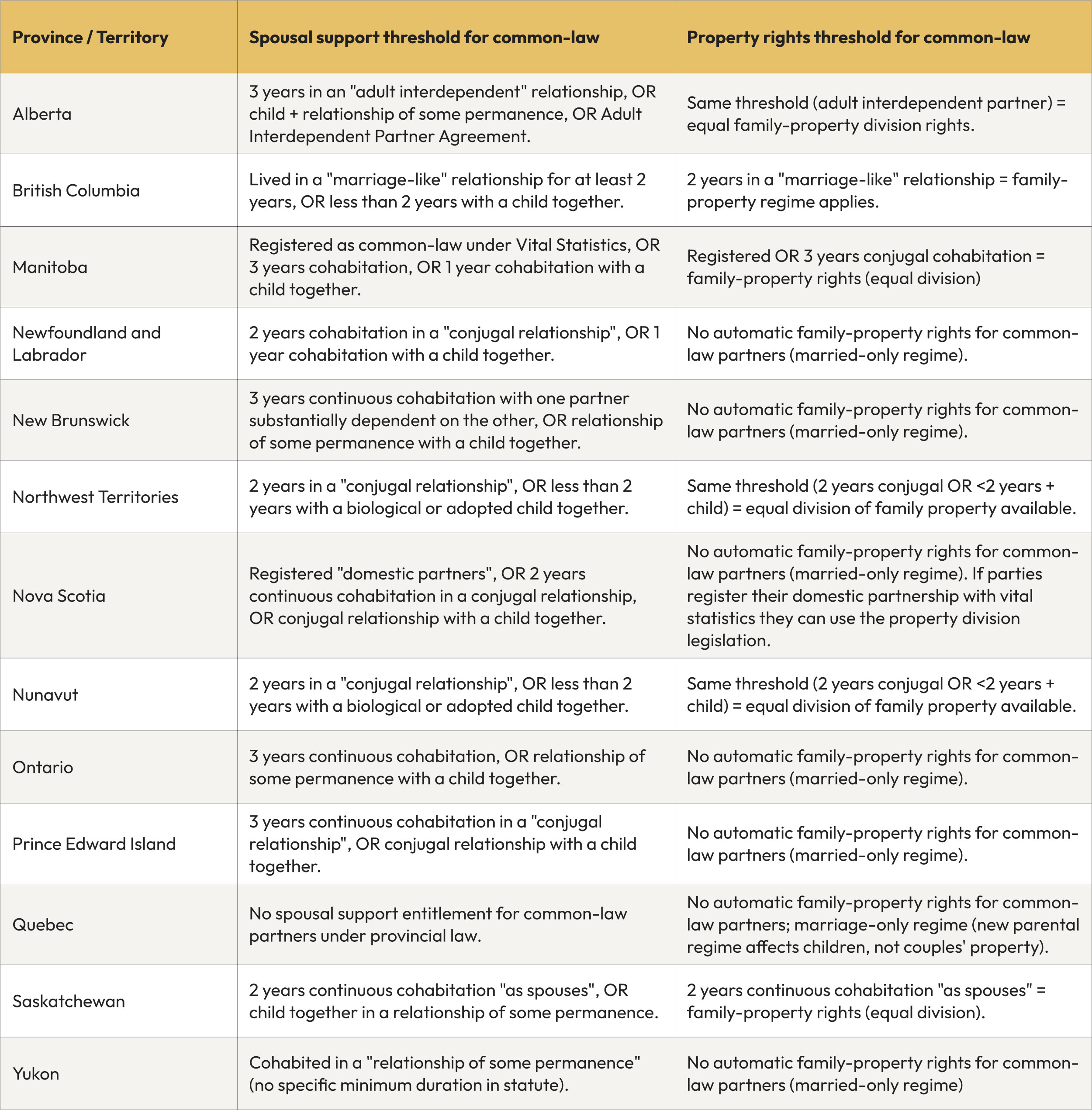
Property rights and spousal support are governed by provincial regulations. The provincial thresholds for common law partnership and for spousal support differ significantly from the federal definition and from each other.

How common law separation differs from divorce for married couples

Property and asset division

This is where the gap between married and common law is most significant. Married couples in most provinces benefit from automatic equalization or division of family property accumulated during the marriage, and the matrimonial home is always included, regardless of whose name is on title.

For unmarried partners there are no automatic property rights in certain provinces.  Check the Property Rights Threshold in the table above for your province. If matrimonial property division legislation does not apply, the default rule is simple and stark: what's in your name is yours, and what's in your partner's name is theirs. Jointly owned property is divided according to actual ownership. 

Even if you contributed significantly to an asset held in your partner's name, then you still have no automatic claim to it if you’re outside of the thresholds listed above. You may have paid for it, contributed through labour, or by taking on parenting responsibilities so the other person could build wealth, you still have no claim to an asset held in your partner’s name.

The provinces where this default does not apply — where common law partners get marriage-like property rights after meeting a cohabitation threshold — are BC, Alberta (since January 1, 2020), Saskatchewan, and Manitoba. If you live in one of these provinces and have been together long enough, your property rights may be much stronger than you realize.

The family home

For married couples, both spouses have an equal right to possession of the matrimonial home regardless of who is on title, and neither can sell or mortgage it without the other's consent.

For common law partners in provinces without automatic property division, the partner whose name is on title or the lease has the legal right to ask the other to leave. This is one of the key distinctions between a married couple and a common law couple in those provinces. 

This reality is one of the most frightening aspects of common law separation for the partner who isn't on title. Courts are reluctant to see it happen in ways that cause undue hardship, and a person who has a spousal support claim may apply for temporary possession. But the protection is not automatic.

Debts

Debt rules are the same for married and common law couples. You are legally responsible for debts in your own name. Joint and co-signed debts leave both parties fully liable to creditors, regardless of what any separation agreement says. A creditor is not bound by an agreement between the two of you. If both names are on the credit card, both remain responsible to the bank.

Spousal support

Common law partners have a legal right to claim spousal support, but unlike married couples, they must first meet an eligibility threshold. In most provinces, this means either three years of living together continuously, or one year of cohabitation with a child together. Some provinces also recognize a "relationship of some permanence" with a child as sufficient. See the thresholds listed above.

Once you cross that threshold, the analysis is the same as for married couples: entitlement is assessed on compensatory grounds (you sacrificed career or opportunity to support the relationship), non-compensatory grounds (the separation leaves you in financial need), or contractual grounds (a cohabitation agreement provides for support). Amount and duration are calculated using the Spousal Support Advisory Guidelines, the same tool used for married couples.

Quebec is the notable exception: common law partners in Quebec historically had no right to spousal support at all, regardless of the length of the relationship. A new parental union regime, effective June 30, 2025, provides some protections for common law couples with children,  but spousal support still does not flow automatically in Quebec for common law partners.

Source: Ontario.ca – Spousal Support

Inheritance

Married spouses typically have automatic rights to inherit a portion of their partner's estate under provincial intestate succession laws. Common law partners in most provinces have no such automatic inheritance rights. If your common law partner dies without a will, you may receive nothing, even after decades together. It’s therefore essential for common law partners to have a will, if you want to protect each other from such a situation.

Pensions

Similarly, pensions accumulated during a marriage are divisible upon divorce in most provinces. Common law partners in Ontario, Quebec, and several other provinces have no automatic right to a share of their partner's pension, unless it was jointly contributed to or they can establish an unjust enrichment claim. BC, Alberta, Saskatchewan, and Manitoba extend pension division rights to qualifying common law couples.

Children: Where the rules are the same

Where it comes to children, common law and married couples are treated largely the same. Parenting decisions and child support are handled under the provincial family legislation, which isn't always identical to the Divorce Act. However, most of the difference is specific wording and the overall effect is generally the same.

Parenting rights apply equally regardless of whether the parents were married. That includes child custody and decision-making responsibility, parenting time, and the best interests of the child framework. Child support is calculated using provincial guidelines, which again is largely the same as Federal Child Support Guidelines, but with some slightly different wording, The amount of Child Support is based on the payor's income, the number of children, and the province of residence. Marital status makes no difference whatsoever to what children are owed or to either parent's obligations.

Source: Legal Line – Common Law Rights Under Family Law

Property claims without automatic division: Unjust enrichment and constructive trust

If you are in a province without automatic common law property division (Ontario, Quebec, Nova Scotia, New Brunswick) and you believe you are entitled to a share of assets in your partner's name, then you must prove a claim on the basis of “Unjust Enrichment” or “Joint Family Venture”, explained below. If a claim succeeds, the remedy is either a constructive trust, giving you actual ownership interest in a specific asset, such as the home or a savings account,  or a monetary award equal to the value of your contribution. A constructive trust is the more powerful remedy, but requires proving a direct causal connection between your contributions and the specific asset.

The provinces in detail

British Columbia

BC's Family Law Act treats common law spouses and married couples almost identically for property purposes once the threshold is met: two years of cohabitation in a marriage-like relationship, or any duration if there is a child together. Family property accumulated during the relationship, including the family home, vehicles, savings, investments, pensions, and business interests, is presumed to be divided 50/50. Pre-relationship property and inheritances or gifts received during the relationship are "excluded property," but any growth in their value during the relationship is divisible.

Example: if a home owned before the common law relationship was worth $800,000 at the start and is worth $1,000,000 at separation, the partner's share of the $200,000 appreciation is $100,000.

Source: Family Law in BC

Alberta

Since January 1, 2020, Alberta's Adult Interdependent Relationships Act and Family Property Act give qualifying common law partners (called an "adult interdependent partner" under Alberta law) the same property division rights as married spouses. The threshold is three years of cohabitation, or a relationship of permanence with a child together. The 50/50 presumption applies to all family property, and couples can opt out with a written agreement signed before or during the relationship.

Source: Alberta – Dividing Property Between Unmarried Partners

Saskatchewan and Manitoba

Saskatchewan's Matrimonial Property Act treats common law couples like married couples for property division after two years of continuous cohabitation. Manitoba provides property rights to common law partners who have formally registered their relationship with the Vital Statistics Agency, or after three years of living together (or one year with a child together). Manitoba also has special home-possession rules after the three-year threshold.

Ontario

Ontario's Family Law Act equalization provisions apply only to married couples. Common law partners in Ontario have no automatic right to share in assets held in their partner's name, no matter how long the relationship, how much they contributed, or how intertwined their lives were. The only path to a share of a partner's separate property is through unjust enrichment or constructive trust litigation.

Jointly held property is divided according to ownership. If both names are on the title or account, both have a claim. If only one name is on title, the other partner has no automatic right. only a potential legal claim.

Source: Ontario Family Law Act

Quebec

Quebec has historically provided the fewest protections for common law couples of any Canadian province. Common law partners (called "de facto unions") have no automatic property division rights and no right to spousal support, regardless of the length of the relationship or the economic sacrifice involved.

A significant change took effect June 30, 2025: a new parental union regime automatically applies to common law couples in Quebec who have children born or adopted on or after that date. Under this regime, family residences, furniture and vehicles are divided equally upon separation, and courts can grant temporary possession of the family home to the custodial parent. Couples can opt out with a notarial agreement. This regime does not apply retroactively to children born before June 30, 2025, unless the couple opts in.

Source: Éducaloi – Common Law Couples in Quebec

Source: Éducaloi – Parental Union: New Rights for Common Law Couples

Nova Scotia and New Brunswick

Nova Scotia has no automatic property division for registered domestic partnership. Each partner keeps their own property, regardless of contributions during the relationship. The result can be significantly unfair, particularly for partners who took on primary caregiving roles. New Brunswick provides spousal support rights after three years of cohabitation, but property division rights vary.

Source: Nova Scotia – Common Law Rights and Responsibilities

Common myths about common law separation

"After living together long enough, I automatically get half of everything."

In most provinces this is not true. There is no automatic 50/50 division for any common law couple. Each partner keeps assets in their own name. The exceptions (BC, AB, SK, MB) have specific thresholds that must be met.

"Common law is basically the same as being married." 

For children: yes. For property: no. In most provinces, marriage creates automatic legal property rights that common law status does not. Inheritance, the family home, and pensions are all treated differently.

"I don't have to pay support because we weren't married."

Not true. Common law partners who meet the eligibility threshold (typically three years cohabitation, or one year with a child, see the table above for more detail) can claim spousal support, calculated the same way as for married couples. Child support is always payable regardless of marital status.

"The house is in my name, so my partner gets nothing." 

This is often true in provinces without automatic division, but a partner who contributed financially or through unpaid labour may have a valid unjust enrichment claim. In BC and Alberta, family homes are divided like matrimonial homes regardless of title.

"If I paid all the bills, I own everything." 

Paying household expenses does not create ownership in assets held in your partner's name. But a partner who made those contributions may be able to argue unjust enrichment because paying bills freed the other partner to accumulate assets.

"We don't need any paperwork — we're not married." 

Common law couples need written agreements more than married couples do, precisely because they have fewer automatic protections. Verbal agreements are not enforceable. Without a written separation agreement, disputes about property, support, and children may require expensive litigation.

"I can leave with the kids — we weren't married." 

Marital status makes no difference to parenting rights. Both parents have equal rights to parenting time and decision-making. A common law spouse has the same parenting rights as a married parent. Removing children without the other parent's consent or a court order can have serious legal consequences.

"After three years common law, I automatically get half their pension." 

In Ontario, Quebec, and other provinces without automatic common law property rights, pensions remain with the pension holder unless a successful unjust enrichment claim is made. BC, Alberta, Saskatchewan, and Manitoba are exceptions.

Separation agreements for common law couples

A written separation agreement is important for every separating couple. In most provinces, it is indispensable. Because common law partners have fewer automatic legal protections, a separation agreement does much of the work that the law does automatically for married couples. It defines what each partner gets, what support will be paid, and how children will be raised. It removes uncertainty. It is far preferable to have a separation agreement, in cost, time, and emotional toll, than to have disagreements decided by a court.

For a separation agreement to be binding, it must be in writing. Verbal agreements are not enforceable. Both parties must have made full financial disclosure: all assets, debts, and income. The agreement must be signed voluntarily, without duress or coercion, and must not be unconscionable (grossly unfair). Both parties should have received independent legal advice before signing.

Practical steps when a common law relationship ends

Below are the steps you would need to take when a common law relationship is coming to an end. Note that you don’t need to do this alone. A legal advisor or divorce mediator (such as Fairway Divorce Solutions) can help you through this process.

1

Note the separation date

The date of your split affects property valuation, support calculations, and limitation periods for legal claims. Document it clearly. If you continue to live under the same roof but "separate and apart" (i.e. separate finances, separate social lives, separate bedrooms), then make a note of when that arrangement began.


2

Protect your financial position early

Joint accounts and credit cards are important to review. Some individuals choose to open separate banking and credit products, while others agree on how shared finances will be managed in the meantime. If both names are on the mortgage, understand that both remain legally responsible regardless of who is living in the home. Monitor your credit report.


3

Inventory all assets and debts

List everything: real estate and its value, vehicles, bank accounts, RRSPs, TFSAs, pensions, business interests, and personal effects — including whose name each is in and how it was acquired. Document all debts with the same rigour. This inventory is the foundation of any negotiation or legal process.


4

Document your contributions

If you are in a province without automatic property division and you believe you have an unjust enrichment claim, start documenting your contributions now. These include both financial contributions such as mortgage payments, household expenses, and renovations, as well as  non-financial contributions such as childcare, unpaid domestic labour, and supporting your partner's career. Keep receipts, bank statements, and records. The burden of proof falls on the party making the claim.


5

Make interim arrangements for children

If you have children, establish a temporary parenting schedule in writing, even if informal. Address where children will live, how parenting time will be shared, and how daily decisions will be made. A written interim plan is better than a verbal understanding. A mediator can help you put one together quickly and with significantly less conflict.


6

Get legal advice specific to your province

The provincial differences in common law property rights are substantial enough that general advice about "Canadian law" can actively mislead you. Understanding exactly what rights you have and what claims are available to you, requires advice grounded in your specific province. If cost is a concern, many law societies offer free or low-cost initial referral consultations, and Legal Aid is available in every province for those who qualify.


7

Formalize everything in a written agreement

A clear, written separation agreement is the foundation of a stable separation, one that both parties understand, can live with, and that will hold up over time. Verbal agreements and informal understandings, however amicable the separation, create ambiguity that tends to resurface when circumstances change. The agreement is strongest when both parties have worked through the issues with the help of a neutral professional, each has received independent legal advice before signing, and support provisions are registered with the provincial maintenance enforcement program (Ontario's FRO, Alberta's MEP, BC's FMEP) for automatic enforcement.


8

Update wills and beneficiary designations

Common law partners have no automatic inheritance rights in most provinces. If your partner has not updated their will, they may still be your estate beneficiary. Update your own will immediately. Also update beneficiary designations on RRSPs, TFSAs, life insurance policies, and pension plans. Sometimes beneficiary designations are a component of a property agreement. These designations typically override what a will says.


Out-of-court options: Why they matter even more for common law couples

The uncertainty of these property claims makes out-of-court resolution especially valuable for common law couples. A negotiated agreement allows both parties to craft a fair outcome without the expense, delay, and unpredictability of asking a court to decide.

Mediation

A neutral mediator facilitates negotiation between both partners. A mediator is neither party's legal advocate, and helps structure conversations about property, support, and children so that both parties can reach their own decisions. Mediation is private, confidential, faster than litigation, and significantly less expensive. It works particularly well for common law separation because it allows creative, customized outcomes that courts cannot easily impose: staggered buyouts, asset trades, flexible parenting arrangements. 

Collaborative Family Law

Both partners retain collaboratively trained lawyers, and possibly additional neutral professionals such as financial specialists, parenting coordinators. Everyone signs a commitment to settle without going to court. If the collaborative process breaks down, the collaborative lawyers cannot represent either party in subsequent litigation and the parties are required to find new representation. This keeps all parties focused on resolution. 

Lawyer Negotiation

Each partner retains a family lawyer who negotiates on their behalf. More formal than mediation and provides individual advocacy, but can still avoid court entirely. Costs vary by lawyer and complexity.

When Court Is Necessary

Court becomes necessary when a partner is unresponsive or refuses to engage, when there are genuine safety concerns, when an urgent interim order is needed, or when all settlement attempts have genuinely been exhausted. Court proceedings are slow, adversarial, and expensive but in some cases necessary, and the enforcement tools available through court orders are meaningful.

Source: Separation.ca – Common Law Property Division

Emotional considerations

Common law separation carries its own emotional weight, and some emotional stressors are very specific to the common law context.

For the partner without property in their name, the fear is often existential: "I have no rights. I have nowhere to go. I built this life and it's all in the other’s name." For the partner who holds the property, the fear is different but real: "I earned this. It's in my name for a reason. Now they want half?" Both perspectives are understandable. Both are informed by real legal uncertainty.

The particular emotional burden of common law separation in provinces like Ontario is this: instead of working within a clear legal framework, both parties may be staring down an unjust enrichment proceeding that could take years and produce an unpredictable outcome. The anxiety of not knowing what you're entitled to  is a significant psychological load on top of the grief of a relationship ending.

Practically advice for your emotional sanity: 

  • get province-specific legal advice as early as possible, so you know what you're actually dealing with;
  • document your contributions now, before memories fade and records disappear;
  • consider counselling: the emotional and legal dimensions of separation are separate processes, and each benefits from professional support;
  • wherever possible, explore mediation before litigation: not because it's always easier, but because it gives both parties more control over the outcome, and typically produces agreements that both can live with.

A different way to separate

Common law separation can feel like navigating without a map, especially in provinces without automatic property rights. The legal framework gives you fewer automatic answers than it gives married couples, which means more depends on what both parties can agree to, and how.

Mediation is especially well-suited to common law separation precisely because of that flexibility. Where the law leaves things uncertain, a structured negotiation process can produce outcomes that both parties recognize as fair, without the cost and unpredictability of a court deciding for you.

Not all mediation processes are the same. A structured, guided approach can make a genuinely complex situation manageable. The Fairway Method brings both parties to a sound Separation Agreement  through financial disclosure, legal education, and step-by-step, independent negotiation with expert support. If you're curious about what that looks like in practice, a free introduction meeting is a no-pressure place to start.

Frequently asked questions

At Fairway, we understand that facing a divorce is daunting, bringing mixed emotions and many questions. We are committed to ensuring that you have the knowledge and tools to move through the process in a way that protects your assets and your children.

Federally, 12 continuous months of cohabitation (or any duration with a child together) qualifies as common law for tax and benefit purposes. Provincially, it varies: Ontario requires three years or one year with a child for spousal support eligibility; BC requires two years for both support and property rights; Alberta requires three years for property rights since 2020.

For children: yes, entirely. For property: in most provinces, no. Common law partners in Ontario, Quebec, Nova Scotia, and several other provinces have no automatic right to share property held in their partner's name. BC, Alberta, Saskatchewan, and Manitoba are the main exceptions, providing marriage-like property division after meeting cohabitation thresholds.

No. Only married couples can divorce under the federal Divorce Act. Common law relationships end when the partners decide to separate — no court process or legal order is required. However, disputes about property, support, and children may still require court involvement through provincial family courts.

In most provinces, each partner keeps assets in their own name and jointly owned assets are divided according to ownership. To claim a share of property solely in a partner's name, the other partner must prove unjust enrichment — a complex legal claim requiring evidence of contribution, enrichment, and no legal justification for the imbalance. BC, Alberta, Saskatchewan, and Manitoba have automatic division rules for qualifying common law couples.

Yes, in most provinces — if you meet the eligibility threshold. This typically means three years of continuous cohabitation, or one year with a child together. Once eligible, support is calculated the same way as for married couples using the Spousal Support Advisory Guidelines. Quebec is the exception: common law partners there generally have no right to spousal support.

In provinces without automatic common law property division — including Ontario — the partner on title generally has the legal right to keep the home. The other partner may claim an interest through unjust enrichment if they contributed financially or through labour. In BC and Alberta, family homes are protected and divided like matrimonial homes regardless of title, once the cohabitation threshold is met.

Strongly yes — and more so than married couples, because they have fewer automatic legal protections. A written separation agreement addresses property, debts, support, parenting, and child support in a legally enforceable way. Verbal agreements are not enforceable. Without a written agreement, disputes may require expensive unjust enrichment litigation.

Identically to married couples. Child support is calculated using the Federal Child Support Guidelines based on the payor's income, number of children, and province. Parental marital status has no effect on child support obligations or either parent's rights.

In Ontario: 10 years for real property claims, 2 years for other property. Time limits vary by province. There is no limitation period for spousal support claims, but delays weaken your case — courts may find that a long-delayed claimant achieved financial self-sufficiency in the interim. Act promptly to preserve your rights.

If the home is solely in their name and you're in a province without automatic common law property rights, they legally can ask you to leave. Courts are reluctant to see this cause severe hardship, and you may apply for temporary possession if you have a spousal support claim. In BC and Alberta, this does not apply — family home protection is similar to that for married couples.